Book a demo

Everything included in a GetRestaurantSite website

Every feature of a GetRestaurantSite website for takeaway, delivery and fast casual restaurants, and which of the three plans carries it.

Book a demo
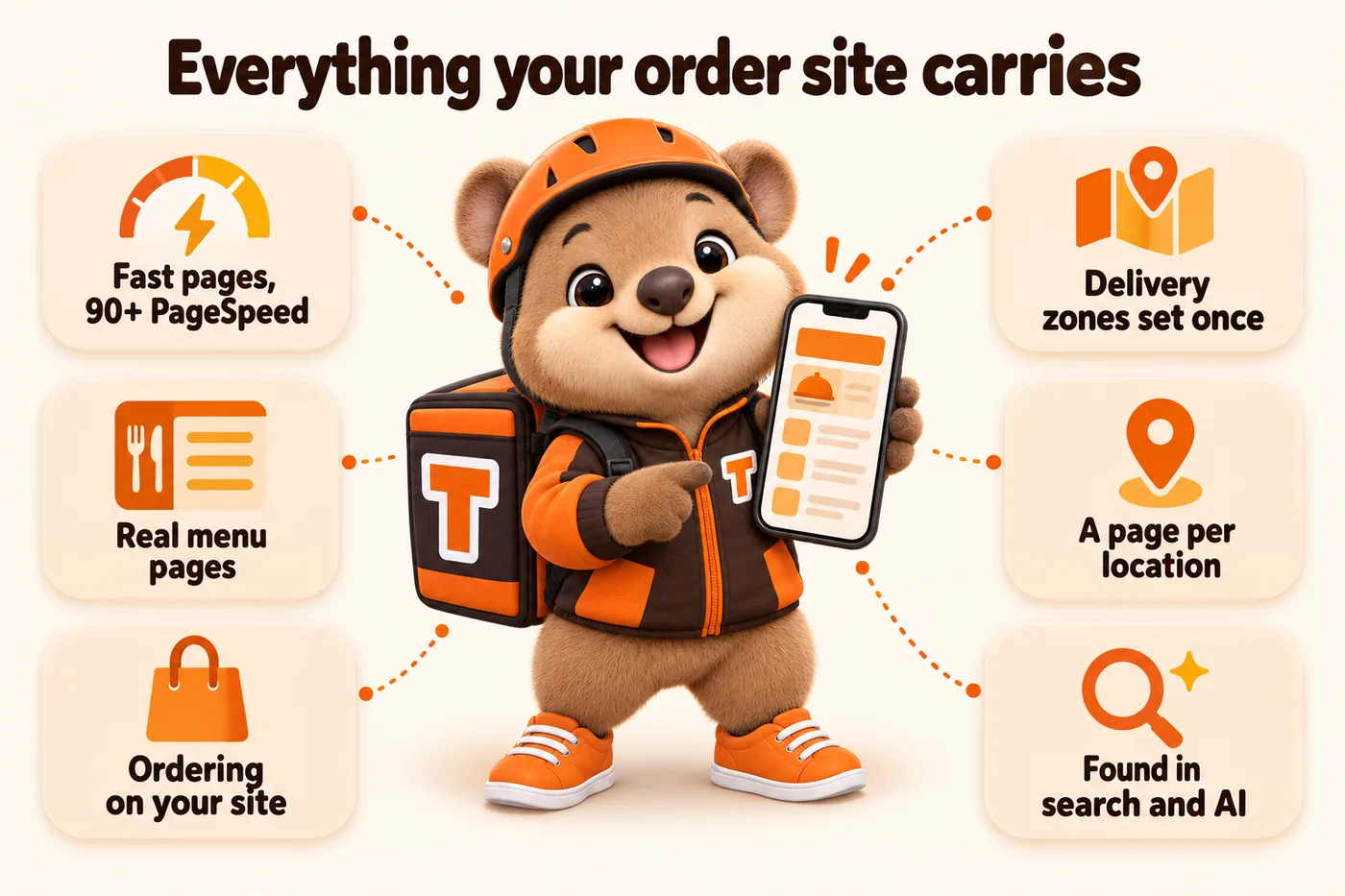
Everything your order site carries: fast pages, 90+ PageSpeed. Real menu pages. Ordering on your site. Delivery zones set once. A page per location. Found in search and AI. Tito holds a phone at the centre

Pages that open instantly

Custom-coded pages served from the edge, 90+ PageSpeed guaranteed.

Included on all three plans

Why speed decides whether the order gets placed

A hungry visitor on a phone gives a slow menu page a few seconds before switching to a delivery app instead. Every page on your site is custom coded, ships almost no JavaScript, and is served from Cloudflare's global edge, so the menu opens instantly on the day the site launches rather than after a plugin audit six months later.

Guaranteed, not aspired to

A 90+ PageSpeed score on both mobile and desktop is part of the build, measured the way search engines and delivery-conscious customers actually experience it. If a new page or a heavy photo ever drags that number down, fixing it is on us, not billed as an extra service call.

Why a fast page makes advertising money go further

If you run ads, you are paying for the click before anyone sees the page. Two things follow from a page that opens instantly. More of the clicks you already paid for turn into a visitor who sees the menu, because fewer people give up while a page loads. And the landing page itself is part of how the ad platform rates your ad: Google Ads Help describes ad quality as an estimate of the experience people have when they see your ad and once they reach your landing page, and says higher ad quality generally leads to better performance, including better ad positions and lower cost. We can build the fast, relevant page. We cannot promise you a specific cost per click, and anyone who does is guessing. Source: Google Ads Help, "About ad quality", accessed September 2026.

Ordering that stays on your site

The order is placed on a page you own, not handed off to a delivery app.

Included on all three plans

The channel you own is the one worth building

A phone call, a walk-in, and a third-party delivery app all get you an order, but only your own website gives you the customer's details, repeat visits with no per-order cut, and a page you control end to end. We build the ordering flow to live on your domain, connected to the CRM, point-of-sale or spreadsheet you already use to fulfill orders.

A checkout built for a hungry visitor

Item selection, modifiers, delivery or pickup choice and payment are laid out as a short, mobile-first flow rather than a generic cart bolted onto a template. Every field earns its place, because each extra step between "hungry" and "ordered" is a chance to lose the sale to whichever app is one tap away.

Delivery zones and pickup times, set once

Accurate delivery areas and pickup windows shown everywhere they matter.

Included on all three plans

One source of truth for where you deliver

Delivery radius, minimum order and pickup windows are configured once and reflected consistently across the homepage, the ordering flow and any location page, instead of living in three different places that drift out of sync. When your delivery area changes for a season or a staffing gap, updating it is a single revision, not a hunt through old pages.

Clear expectations reduce cancelled orders

A customer who knows the real pickup window or sees plainly that their address falls outside the delivery zone before checkout is far less likely to place an order your kitchen has to cancel. The site states these facts plainly rather than leaving them to a surprise phone call after the order is in.

A real page for every location

Each location gets its own page with its own hours, menu notes and directions.

Included on all three plans

Why one location page is not enough for two kitchens

A single "our locations" section with two addresses gives search engines almost nothing to match against a search for takeaway near a specific neighborhood. Each location gets a real page: its own hours, its own delivery zone, any menu differences, directions and a direct path to order from that kitchen.

Built to grow with a second or third location

Adding a location later is a revision that follows the same structure as the first, so a customer never lands on a page that reads differently from the rest of the site. Whether you run one counter or five, every location gets equal treatment.

Reviews shown where they influence the order

Genuine review content placed near the menu and the checkout, not hidden on a separate page.

Included on all three plans

Proof works best right before the decision

A review placed near the item someone is deciding on, or right before checkout, does more work than the same review buried on a standalone testimonials page nobody visits. We design the layout to surface your genuine reviews at the moments they actually influence whether an order gets placed.

Real reviews only

This feature displays reviews you have actually received, pulled from the platforms you use or added by you. We do not write, invent or embellish a review on your behalf, and nothing on the site claims a rating or a review count that is not real.

Found in search, in maps and in AI answers

Technical SEO, answer-first content and structured data, on every plan.

Included on all three plans

SEO: the technical work and the pages that carry it

Search visibility for a kitchen comes from three things done properly: a site fast enough to be crawled and enjoyed, pages that exist for the things people search, and clean signals about who and where you are. We handle the technical side (titles, descriptions, headings, canonical addresses, sitemaps, internal links, image alt text, no broken redirects) and we build the pages: one per menu section worth its own page, one per location, one per service area you actually deliver to. Location pages are built for your cities and neighborhoods, which is where a search for food near a place turns into an order.

AEO: written so the answer can be lifted

Answer engine optimization means the first sentence under a heading answers the heading, questions are phrased the way a customer asks them, and facts like delivery radius, pickup window and catering lead time are stated plainly instead of buried in a paragraph. That structure is what gets pulled into a featured snippet, a voice answer or an assistant's reply. Your FAQ blocks are visible on the page and marked up, never markup alone.

GEO: being citable by AI assistants

Assistants such as ChatGPT, Claude, Perplexity and Google's AI Overviews summarise sites they can parse and trust. We publish a plain-text llms.txt file describing your kitchen and its key pages, keep your business name, address, hours and service area identical everywhere they appear, and write facts in a quotable form. Nobody can guarantee an appearance in an AI answer, and we do not. What we control is whether your site is readable, consistent and worth citing.

Structured data, generated from your real pages

Your site carries JSON-LD for the things search engines ask about a restaurant: the business itself with its hours, address and service area, each menu or service page, your FAQ blocks, and breadcrumbs. Review markup is added only where you have genuine reviews, never invented. Structured data is what lets a result show your hours or your questions directly, and it is generated from the same content the visitor reads, so the two never drift apart.

The ranking window we put in writing

The terms commit to your site starting to rank for local searches in your area within 3 to 5 months of launch, and to continuing the search work at no extra charge if it has not. That is a commitment about work, not a promise of a position: nobody controls a search engine, and any supplier who says otherwise is selling you something they cannot deliver.
Researched articles, published on a schedule

New content published weekly, not just at launch.

Included on all three plans

A site that keeps publishing ranks differently than one that does not

Search engines and AI answer tools both favor sites that keep adding relevant content, which is why every plan includes researched articles published on a schedule rather than a one-time content package at launch. Articles link back into your menu and location pages, compounding the value of the page architecture over time.

Written for people who are deciding where to order from

Articles cover the topics someone actually searches before choosing a takeaway spot: what makes a delivery order arrive hot, how a fast casual counter handles a rush, or what a catering order from a small kitchen looks like. Nothing is written as generic filler; every piece is specific to the kind of restaurant the site is built for.

Hosting, security and backups, handled

Cloudflare hosting with SSL, CDN and backups included in the monthly fee.

Included on all three plans

Nothing to manage, nothing to renew

The site runs on Cloudflare's global network with SSL, CDN, DDoS protection and unmetered bandwidth included in the monthly fee. There is no separate hosting invoice, no SSL certificate to renew, and no bandwidth overage to worry about during a busy weekend rush.

We watch it so you do not have to

Uptime, platform updates and security patches are handled on our side. If something needs attention, it is fixed as part of the plan, not raised as a separate line item or left for you to notice when the site goes down during service.

Moving off your current site, without losing what you built

We rebuild what is worth keeping and redirect the old addresses.

Included on all three plans

Whatever you are on now, including a delivery app's free site

A lot of kitchens are on a site the delivery app gave them, an old page-builder site nobody has the login for, or a template a relative built in 2019. We look at what exists during onboarding and rebuild the parts worth keeping: menu, photography, copy that already sounds like you, and any page that is bringing in traffic.

Old addresses keep working

If your current site ranks for anything, we set up redirects from the old page addresses to their new equivalents so that visibility is not lost in the switch. The new site is built and reviewed before your domain is ever pointed at it, so there is no window where a customer finds nothing. A printed menu or a sticker on the window with your old address keeps working.

The domain stays yours

If you already own a domain we point it at the new site. If you do not, one is registered in your name and included for as long as your plan is active. Either way you own it, and if you ever leave, you tell us where to transfer it and we move it at no charge.

The policy pages your site ships with

Privacy, order terms, cookie consent, accessibility and an allergen disclaimer, written for a kitchen.

Included on all three plans

Written for a restaurant, not pasted from a generator

Your site ships with a privacy policy, terms for online orders, a cookie policy with consent that actually holds non-essential scripts until someone agrees, an accessibility statement, an allergen and nutrition disclaimer in your own words, consent wording on any form that takes a mobile number, and a copyright and takedown route. They are written around what your site really does: takes orders, quotes delivery zones, books catering.

Built with accessibility in mind from the start

Pages are keyboard operable, contrast is checked against the real palette, form fields are labelled, and menu photography carries alt text. An inaccessible menu is not only a legal exposure, it is an order you never receive. This is a build practice, not a plugin bolted on at the end.

What we will not do

We help you meet the expectations that apply to a restaurant website. We do not guarantee compliance, we do not give legal advice, and we never write food safety, allergen or nutrition advice on your behalf. If your state, county or franchisor adds a requirement, send it to us and the page gets built around it as a normal revision.

One place for revisions, tickets and files

Your account with us from launch day: every request tracked, nothing lost in an inbox.

Included on all three plans

How a change actually gets made

You describe the change in the portal, attach whatever we need, and it lands with the team as a tracked request you can follow. 5 revisions a month are included on every plan and a revision has no size limit: a sold-out item and a rebuilt menu page both count as one. Everything is completed within 2 to 5 working days.

Support, files and messages in the same place

The portal is also where you raise a support ticket, send us the photographs you promised during onboarding, and message the team directly. You never log in to the website itself and there is no dashboard to learn: the site is ours to operate, the decisions are yours.

The AI Engine

A receptionist, a chat widget and messaging agents, all answering from your kitchen's own facts.

Included on Order Engine and Full Kitchen

What the AI Engine is, in one paragraph

The AI Engine is three things working from one set of facts about your kitchen: a receptionist that picks up calls your team cannot, a chat widget on the site, and messaging agents that reply to texts. All three answer the same questions the same way, because they read the same hours, menu, delivery zones and policies. You review the scripts before launch, and you decide what they are allowed to say.

Trained on your kitchen, not a generic script

During onboarding we load your actual hours, menu, delivery zones, catering lead times and policies, so answers reflect your business rather than a template. It never gives food safety, allergen or nutrition advice on your behalf, and it never invents an answer it was not given: anything outside its scope is handed to a person at your business.

What it costs and how it is billed

Order Engine and Full Kitchen include the AI Engine. Usage on it is billed monthly in arrears at what our providers charge us, with no markup from us, which is why the plan price is written as a monthly fee plus usage rather than a single number that would quietly hide it.

Your obligations, stated plainly

Text messaging requires carrier registration (A2P 10DLC) and we file that for you, with carrier fees passed through at cost. Consent, opt-out handling and record keeping for your own communications stay yours, because they are about your relationship with your customers. We build the consent wording into the forms; using it correctly is the part only you can do.

The AI receptionist for calls you cannot take

Answers the phone when the kitchen cannot, takes the details and books what can be booked.

Included on Order Engine and Full Kitchen

The problem it solves on a Friday at seven

Every kitchen loses calls at exactly the moment it is busiest, and again after close. The caller does not leave a voicemail; they call the next place on the list. The AI receptionist answers on the plans that include it, using your hours, delivery zones, menu and policies, and takes the caller's details instead of letting the call ring out.

What it is allowed to do

It describes your business, answers the questions you have given it answers to, takes enquiry details and books what you let it book, such as a catering enquiry or a callback. It is configured not to give professional or food safety advice, and to hand anything that would amount to advice to a person at your business. You see the script before it goes live.

What you have to do

Approve the script and tell us where the details should land. After that, nothing: there is no console to watch and no phone tree to maintain. If you want it to stop answering during service, or to answer only after hours, that is a setting we change as a normal revision.

A chat widget that answers instead of collecting emails

On-site chat that answers the real question, then hands over to you when it matters.

Included on Order Engine and Full Kitchen

Most restaurant chat widgets are a form in disguise

The usual widget asks for a name and an email and promises someone will be in touch, which is no use to a hungry person deciding between you and the place next door. Yours answers: how far you deliver, what time the kitchen closes, whether the wings are available tonight, how much notice a catering tray needs.

It knows when to stop talking

Anything it was not given a confident answer to becomes a handover: the visitor's details and the conversation come to you rather than a guess going to them. That boundary is the difference between a chat widget that helps and one that has to be switched off after a bad week.

Text messaging that replies while you are plating

SMS conversations answered and routed, with carrier registration filed for you.

Included on Order Engine and Full Kitchen

Where the messages actually come from

Regulars text. So do catering customers, delivery drivers and the office manager ordering fifteen sandwiches. On the plans that include the AI Engine, those messages get answered from the same facts as the phone and the chat widget, and anything that needs you is passed straight through with the context attached.

Carrier registration handled

Business texting in the United States requires A2P 10DLC registration, and unregistered traffic gets filtered or blocked by the carriers. We file the registration for you as part of the build and pass through carrier fees at cost. Consent wording is built into every form that takes a mobile number.

What stays yours

Consent, opt-out requests and record keeping for your own messages are your responsibility, because they belong to your relationship with your customer. We build the mechanics and tell you plainly where the line is, rather than leaving you to discover it from a carrier.

The Content Engine

A higher publishing cadence and social content, on Full Kitchen.

Included on Full Kitchen

More content, on a faster clock

Full Kitchen steps up the articles published each week and adds social post drafts built from the same research, so your feed and your site are saying the same thing without you writing either one. It is the plan built for an operator ready to compound their content advantage rather than just keep pace.

Consistency without a content team

Every piece follows the same research and review process as the articles on every other plan, just more often. You still approve anything that goes out under your name; the Content Engine handles the researching and drafting, not the final call.

Social posts and reels, drafted from the same research

3 social posts and 2 reels a week on Full Kitchen.

Included on Full Kitchen

What lands each week

Full Kitchen adds 3 social posts and 2 reels a week, drafted from the same research as your articles so the feed and the site are telling one story rather than two. You approve what goes out; nothing is published under your name without you seeing it.

Why it is tied to the site, not separate from it

A post that points at a real page on your own domain sends the visitor somewhere they can order. A post that ends in a delivery app link sends them somewhere that charges you for the introduction. Everything drafted here points back at the menu, the catering page or an article you own.

Tier matrix

Every feature, every plan

Feature availability by plan
FeatureOrder StarterOrder EngineFull Kitchen
Pages that open instantlyYesYes
Menu pages built to be cravedYesYes
Ordering that stays on your siteYesYes
Delivery zones and pickup times, set onceYesYes
A real page for every locationYesYes
Reviews shown where they influence the orderYesYes
Found in search, in maps and in AI answersYesYes
Researched articles, published on a scheduleYesYes
Hosting, security and backups, handledYesYes
Moving off your current site, without losing what you builtYesYes
The policy pages your site ships withYesYes
One place for revisions, tickets and filesYesYes
The AI EngineNoYes
The AI receptionist for calls you cannot takeNoYes
A chat widget that answers instead of collecting emailsNoYes
Text messaging that replies while you are platingNoYes
The Content EngineNoYes
Social posts and reels, drafted from the same researchNoYes

Features in use

What these features did for one kitchen each

  • People used to ring just to check their takeaway ordering form had actually gone through. Now the sender gets a summary, the next step in plain language, and a way to correct mistakes. It sounds minor until you add up the reassurance calls it has replaced.

    Sophia BarringtonFront of house lead, Kebab and grill takeawayReno, Nevada

    Submission acknowledgment and follow-up for takeaway ordering

  • The question 'who is answering this one?' used to hang over every takeaway ordering inquiry. Requests are assigned automatically, with a backup for when the owner is away. Duplicate replies and orphaned messages have both quietly ended.

    Warren GladstoneEvening shift supervisor, Turkish ocakbasi takeawayTulsa, Oklahoma

    Inquiry assignment and staff handover for takeaway ordering

  • The guided contact options looked like a small feature; they changed the inbox. The sender picks the route, which means the best-informed person does the sorting. Visitors get a simpler page and we get a clearer inbox.

    Mark EllsworthShift coordinator, Chinese takeaway with collection counterTacoma, Washington

    Inquiry categories and guided navigation for takeaway ordering

Be fair about it

How this list compares with a builder or an agency

There are cheaper ways to have a website and better ways to spend money than on us, depending on your kitchen. We wrote ten comparisons that say so out loud, including the cases where you should stay exactly where you are.

Read all ten comparisons

Every page names what the other option is genuinely better at, and how the two can work together.

How the features work together

From menu to order to a site that keeps growing

  1. Menu built

    Categories, modifiers and combo pricing structured from your real menu.

  2. Order placed

    Delivery or pickup, checked against your zone, on your own domain.

  3. Order routed

    Sent straight to your POS, kitchen display or CRM.

  4. Site keeps growing

    Weekly articles and revisions compound the site's reach over time.

Questions about the features, speed and search

What are the researched articles actually about?

Topics people search before choosing where to order from: what makes a delivery order arrive hot, how a fast casual counter handles a lunch rush, or what a catering order from a small kitchen looks like. 2 articles a week publish on Order Starter and Order Engine, and 3 a week on Full Kitchen, each 2,500 to 3,200 words.

Can we suggest article topics ourselves?

Yes. Send topic ideas, seasonal specials or a new menu direction you want covered, and we work them into the schedule. If you do not suggest anything, we choose topics based on what people actually search for in your niche.

What does the AI Engine actually do for a restaurant?

On Order Engine and Full Kitchen, the AI Engine answers the questions your site gets asked most, such as delivery hours, catering lead time or whether an item is available today, using the facts you give us about your kitchen. It also drafts review replies for your approval, so a busy shift never means a review sits unanswered for a week.

Does the AI Engine give food safety or allergen advice?

No. We are a website design and management company, not a food safety authority, and the AI Engine never gives food safety, allergen or nutrition advice on your behalf. Any question that touches those topics is routed to a human answer you control.

How fast will my menu page actually be?

Every page is built to a 90+ Google PageSpeed score on mobile and desktop, and that target is in the terms rather than in a sales line. Pages are custom coded, ship almost no JavaScript and are served from a global edge network. If a page ever falls below the target because of our work, fixing it is on us.

Does a faster site make my ads cheaper?

It can help, and we will not promise a number. Two things are true. You pay for a click before anyone sees the page, so every visitor who gives up during a slow load is money already spent. And the landing page is part of how an ad platform rates your ad: Google Ads Help describes ad quality as an estimate of the experience people have when they see your ad and once they reach your landing page, and says higher ad quality generally leads to better performance, including better ad positions and lower cost. Anyone quoting you a specific cost-per-click drop is guessing.

Who checks the speed after launch?

We do, every week, as part of the plan. A new photograph, a new page or an added embed can all drag a score down, which is why the check is scheduled rather than left until someone complains.

What do you actually do for SEO?

The technical work and the pages that carry it: titles, descriptions, headings, canonical addresses, sitemaps, internal links and image alt text, on a fast site, plus a page for each location and each delivery area you really serve. We do not build empty pages for towns you do not deliver to, because search engines filter that and it drags down the honest pages.

What is AEO, and why does it matter for a takeaway?

Answer engine optimization is writing so the answer can be lifted out: the first sentence under a heading answers the heading, and facts like delivery radius, pickup window and catering lead time are stated plainly. That is the structure that gets pulled into a featured snippet or a voice answer, which for a hungry customer is often the only result they see.

Can you get my restaurant mentioned by ChatGPT or Google AI Overviews?

We can make it much more likely and nobody can guarantee it. What we control is whether an assistant can parse and trust your site: a plain-text llms.txt describing the kitchen and its key pages, business name, address, hours and service area identical everywhere, facts stated in a quotable form, and clean structured data. Any supplier promising a guaranteed AI mention is selling something they do not control.

See every feature built into your own menu

A live demo shows these features against your actual dishes, not a placeholder menu.

Book a demo