Book a demo

Built for takeaway, delivery and fast casual

A website built to get the next order placed

A managed, custom-coded website for takeaway, delivery and fast casual restaurants: live in 7 days, 90+ PageSpeed, weekly updates, researched articles and hosting included, from one monthly fee.

  • Live in 7 days
  • 90+ PageSpeed
  • $117 a month
Live in 7 days
No commission on owned orders
90+ PageSpeed
Tito, the GetRestaurantSite mascot, riding his delivery scooter and waving with a takeaway bag

Built for kitchens that live and die by the order queue

Pizza deliveryAsian takeawayFried chickenFast casual burgersSandwich shopsFood trucksGhost kitchensPizza takeaway

7

Days to launch

5

Revisions a month

90+

PageSpeed target

$117

From, a month

From the counter

What changes when the site is built around the order

  • The guided contact options looked like a small feature; they changed the inbox. The sender picks the route, which means the best-informed person does the sorting. Visitors get a simpler page and we get a clearer inbox.

    Mark EllsworthShift coordinator, Chinese takeaway with collection counterTacoma, Washington

    Inquiry categories and guided navigation for takeaway ordering

  • We shut at five-thirty. The takeaway ordering inquiries do not, and now the website copes with that. People leave the relevant details and see plainly when to expect a reply. The morning inbox is a work list now, not a puzzle.

    Gabriel AshfordCustomer service lead, Gourmet burger takeawaySavannah, Georgia

    After-hours inquiry capture for takeaway ordering

  • Updating takeaway ordering content used to mean describing a change by phone and hoping. The request format is short and explicit, and the preview shows exactly what will change. Far easier than narrating edits and hoping they survived the telling.

    Wilfred WaverlyCustomer inquiries supervisor, Peri-peri chicken shopReno, Nevada

    Content approvals and change requests for takeaway ordering

The cost of leaving it

What the current site costs you every week it stays the same

We are not going to invent a number for your kitchen. Here is where the money actually leaks, and how to price each one from figures you already have.

  • Commission on orders you already earned

    A regular who found you two years ago still orders through an app, and the app still takes its cut of every ticket. That is not a marketing cost, it is a tax on a customer you already own.

    Count last month's app orders from repeat customers, multiply by the commission rate in your app agreement.

  • Calls nobody could answer

    Every unanswered call during service, and every call after close, goes to whoever picks up next. Nobody leaves a voicemail about wings.

    Ask your phone provider for missed calls between 6pm and 9pm last week.

  • Visitors who left before the menu loaded

    A slow menu page on a phone loses the person who was already hungry and already on your site. They do not complain, they just open an app.

    Run your current menu page through PageSpeed Insights and compare it with the 90+ target we build to.

  • Searches in your own neighborhood that go elsewhere

    If your site has no real page for the area you deliver to, the search that should have found you finds a competitor two blocks away.

    Search your food type plus your neighborhood on a phone and see where you land.

  • Staff time spent working around the website

    Re-exporting a PDF menu, telling people on the phone what is on it, correcting a price that changed in March: none of that is cooking, and all of it is paid.

    Add up the hours somebody spends on menu admin in a month, at what you pay them.

  • Being invisible when an assistant answers for you

    People now ask an assistant where to order from. A site with no clear facts about hours, delivery area or menu cannot be quoted back to them.

    Ask an AI assistant where to get your food type in your city and see who it names.

Add those six up for one month. That figure is the real comparison for a monthly plan.

Put it against the plans

What usually goes wrong

The site is quietly costing orders

Five problems we see on almost every takeaway, delivery and fast casual site before we rebuild it.

The menu is a PDF

A scanned menu behind a QR code means every price change is a whole new file to export and re-upload.

A cut on every order

Ordering only exists inside a delivery app, so every sale pays a commission before it reaches your kitchen.

A delivery zone that is a guess

No real map, so drivers get sent to addresses outside their route.

A slow menu page

A hungry visitor gives a slow page a few seconds before switching to an app instead.

The phone still rings for the menu

Customers call to ask what is available because the site never really answers it.

The order channel flow

One order, four channels, one you actually own

An order can arrive four different ways. Follow where each one goes, and notice which one keeps coming back to you.

An order is ready to be placed

Your own site

You own this one

The order is placed, paid for and confirmed on a page you control, connected straight to your kitchen system. No per-order cut, and you keep the customer's details for next time.

Phone orders

Still real, especially for regulars, but every call ties up a staff member during the busiest part of service and leaves no record for a repeat order later.

Walk-in and counter

Works well in person, but a walk-in customer who checks your site first still needs a menu that loads instantly and answers what they came to ask.

Third-party delivery apps

Useful for discovery and reach, but every order through an app takes its own cut and hands the customer relationship to the platform, not to you.

The channel you keep, whichever door they walked through

This is not about dropping the other channels. It is about making sure the one with no commission and no middleman is also the best one on offer.

Speed and ad spend

A fast page makes the traffic you already pay for go further

Speed is not a bragging number on this site. It decides how many of the people you paid to reach actually reach your menu, and it is one of the things an ad platform judges your ad by.

  • Custom coded, no page-builder weight
  • 90+ PageSpeed, mobile and desktop
  • Re-checked every week after launch
How the speed work is done
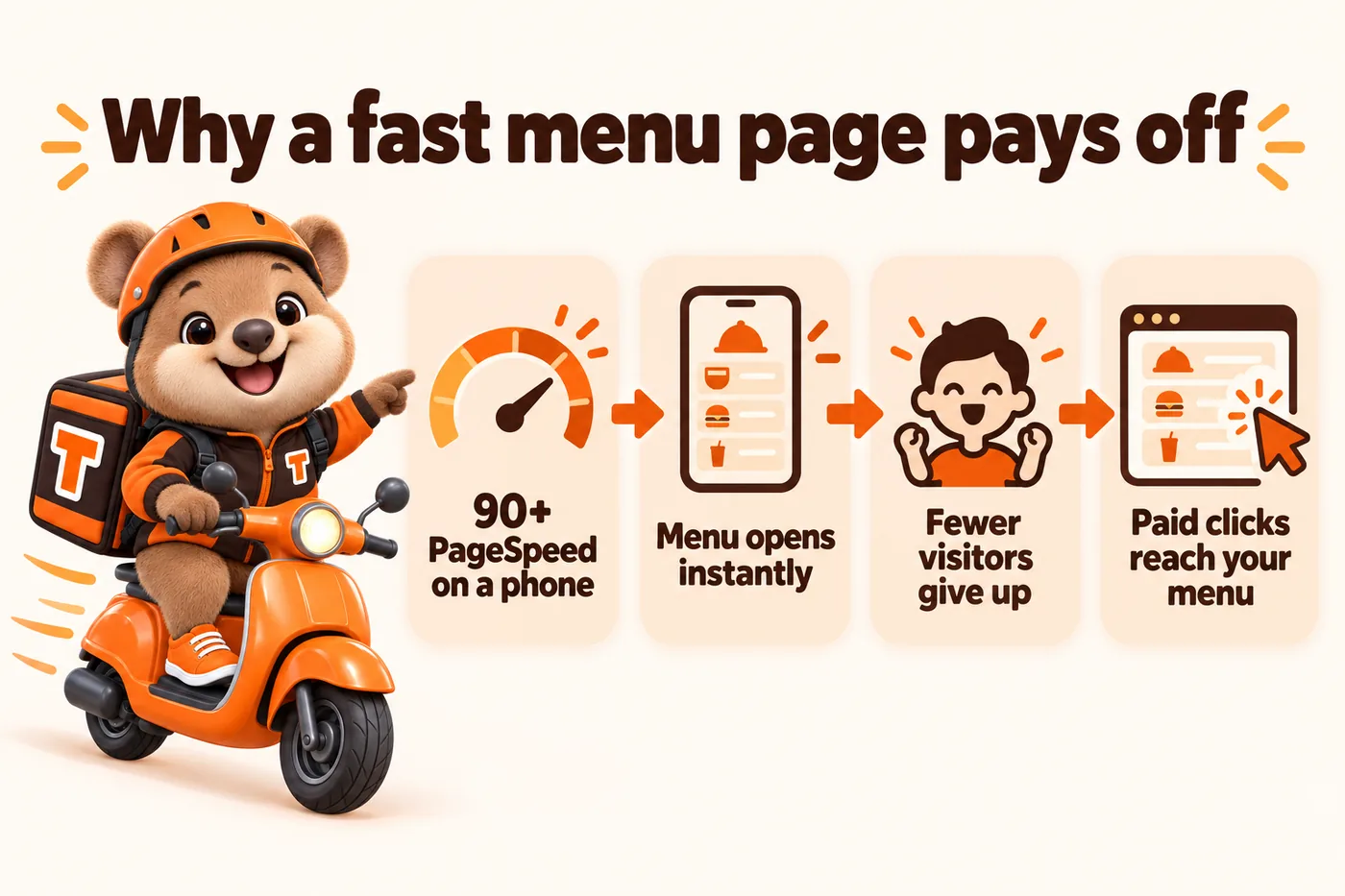
Why a fast menu page pays off: 90+ PageSpeed on a phone, menu opens instantly, fewer visitors give up, paid clicks reach your menu. Tito rides his scooter beside the chain
  • You pay for the click before anyone sees the page

    Whether the click came from an ad, a map listing or a search result, the cost is already spent by the time your page starts loading. Every visitor who gives up during that wait is money you have already paid out.

  • Built to a 90+ PageSpeed target, on a phone

    Pages are custom coded, ship almost no JavaScript and are served from a global edge network, so the menu opens on a phone on a weak connection at 6pm. That is the moment that decides the order.

  • The landing page is part of how ads are rated

    Google Ads Help describes ad quality as an estimate of the experience people have when they see your ad and once they reach your landing page, and says higher ad quality generally leads to better performance, including better ad positions and lower cost. A fast, relevant menu page is the part of that we can actually build.

  • What we will not claim

    No percentage, no promised cost per click, no ranking guarantee bought with speed. Auctions move for reasons nobody outside the platform controls. We build the fast page and tell you plainly what it does and does not decide.

Source: About ad quality. Google Ads Help, "About ad quality", accessed September 2026.

Search, answers and AI

Found in search, on the map, and inside AI answers

Four different jobs, all included on every plan. People still search, but they also ask an assistant, and a kitchen that is invisible to one is usually invisible to both.

SEO

The technical work, plus pages that deserve to rank

Titles, descriptions, headings, canonical addresses, sitemaps, internal links and image alt text handled properly, on a site fast enough to be crawled and enjoyed. Then the pages themselves: one per location, one per area you really deliver to, one per menu section worth its own page.

Location pages are built for your cities and neighborhoods, which is where a search near a place turns into an order.

AEO

Written so the answer can be lifted out

Answer engine optimization means the first sentence under a heading answers the heading, and the facts a customer asks for, delivery radius, pickup window, catering lead time, allergen policy, are stated plainly instead of buried.

FAQ blocks are visible on the page and marked up, never markup alone. Hidden answers break the rules and help nobody.

GEO

Citable by ChatGPT, Claude, Perplexity and AI Overviews

Assistants summarise sites they can parse and trust. Your site publishes a plain-text llms.txt describing the kitchen and its key pages, keeps your name, address, hours and service area identical everywhere, and states facts in a quotable form.

Nobody can guarantee an appearance in an AI answer, and we do not. We control whether you are readable, consistent and worth quoting.

Schema

Structured data generated from the visible page

JSON-LD for the business itself with hours, address and service area, for each service or menu page, for your FAQ blocks and for breadcrumbs, all generated from the same content a visitor reads so the two never drift apart.

Review markup is added only where you have genuine reviews. We never generate a rating that does not exist.

We build the location and service-area pages for wherever you actually trade, from a single counter in Texas to four shops across Texas, Florida and California. What we never do is spin up empty pages for towns you do not deliver to: search engines filter that, and it drags down the pages that were honest.

The terms commit to your site starting to rank for local searches in your area within 3 to 5 months of launch, and to continuing the search work at no extra charge if it has not.

How the local search work runs
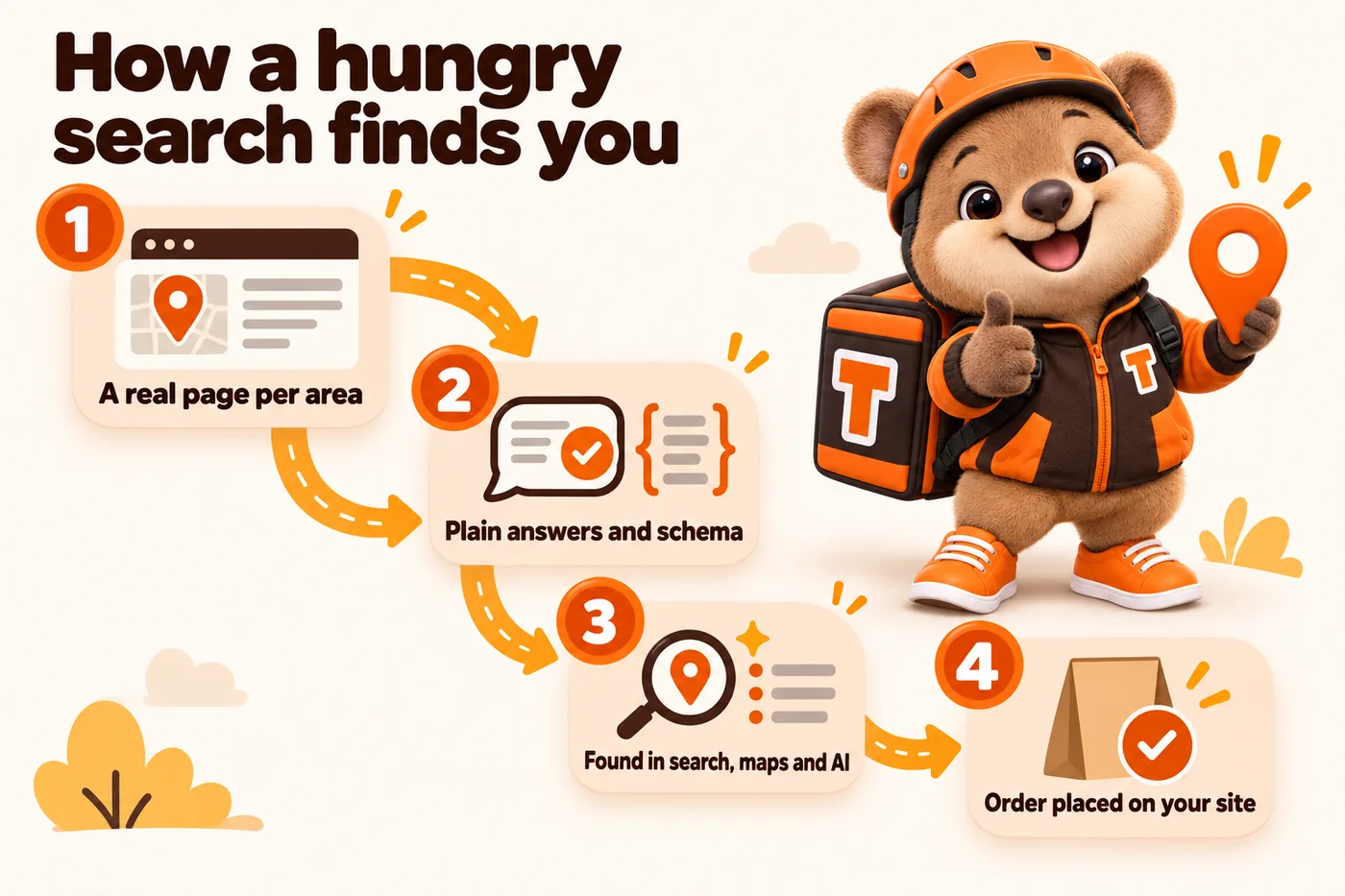
How a hungry search finds you: 1, a real page per area. 2, plain answers and schema. 3, found in search, maps and AI. 4, order placed on your site. Tito gives a thumbs-up at the last stop

Before and after

What actually changes when we rebuild it

Six of the most common differences between the site a kitchen has and the one it gets from us.

  • Menu
    Before:A scanned PDF behind a QR code that goes stale the moment a price changes.After:Real web pages, updated as a revision the same week the counter price changes.
  • Ordering
    Before:Every online order routes through a delivery app and pays its cut.After:Orders can be placed on your own site, connected straight to your kitchen system.
  • Delivery zone
    Before:No real map, so drivers get sent outside their actual route.After:A configured zone checked against the address before the order is confirmed.
  • Speed
    Before:A slow page loses the visitor who was about to order.After:90 or higher PageSpeed, custom coded, guaranteed on both mobile and desktop.
  • Locations
    Before:One page lists every address in a single sentence.After:A real page per location, with its own hours, zone and menu notes.
  • Content
    Before:The site has not changed since it launched.After:Researched articles publish on a weekly schedule, every plan, every week.

What you get

Everything below is on every plan

Order Engine and Full Kitchen add the AI Engine and the Content Engine on top of this. Nothing below is an add-on.

Owned online ordering

Checkout on your own domain, connected to your kitchen system.

Delivery zones and pickup times

Set once, shown accurately everywhere on the site.

A page per location

Its own hours, delivery zone and menu notes.

Researched articles

2 to 3 a week, on a schedule.

Managed hosting

Cloudflare, SSL, CDN and backups included.

Ongoing revisions

5 a month included, of any size.

See the full feature breakdown

Included on Order Engine and Full Kitchen

The AI Engine is a receptionist, a chat widget and a texter

All three answer from one set of facts about your kitchen, so the phone, the site and a text message never contradict each other. You approve the scripts before any of it goes live.

  • The receptionist that picks up when the kitchen cannot

    The problem
    Calls during service and after close go unanswered, and nobody leaves a voicemail about wings.
    What it does
    Answers using your hours, menu, delivery zones and policies, takes the caller's details and books what you allow it to book.
    What you do
    Approve the script once and tell us where the details should land.

    Order Engine and Full Kitchen

    Read how it works
  • The chat widget that answers instead of collecting emails

    The problem
    A hungry visitor asks a question at 7pm and gets "someone will be in touch".
    What it does
    Answers delivery range, closing time, availability and catering notice on the spot, and hands anything uncertain to you with the conversation attached.
    What you do
    Nothing. It is switched on at launch and tuned as a normal revision.

    Order Engine and Full Kitchen

    Read how it works
  • Messaging agents for the texts you never get to

    The problem
    Regulars, catering customers and drivers text, and the phone sits face-down on a prep bench.
    What it does
    Replies from the same facts as the phone and the chat, and passes anything that needs you straight through.
    What you do
    Nothing except consent decisions. We file the A2P 10DLC carrier registration and pass carrier fees through at cost.

    Order Engine and Full Kitchen

    Read how it works

None of the three gives food safety, allergen or nutrition advice on your behalf. Anything that would amount to advice is handed to a person at your business. Usage is billed monthly at what our providers charge us, with no markup, which is why Order Engine is written as a monthly fee plus usage.

Where we build

Kitchens across the United States

We build for takeaway, delivery and fast casual kitchens anywhere in the United States. A single counter in Texas, a delivery kitchen in Florida and a four-shop brand in California are the same build to us: the work happens remotely and the pages are written for your area, not ours.

States we are set up to build for, among others:

  • Texas
  • Florida
  • California
  • New York
  • Illinois
  • Georgia
  • Arizona
  • North Carolina
  • Ohio
  • Pennsylvania

We do not publish a page for every town in the country. Thin location pages are filtered by search engines and drag down the honest ones. Your site gets a real page for each place you actually trade.

A courier heading out with an insulated bag, the delivery radius a site has to state honestly
Photo by Norma Mortenson on Pexels
  • Built remotely, everywhere in the country

    We build and manage the site remotely, so a single counter in one town and a four-location brand in another get the same team. Support runs 9:00 to 17:00 Central Time, Monday to Friday, and revisions are completed within 2 to 5 working days wherever you are.

  • Your pages are built for your area, not ours

    Delivery zones, pickup windows, neighborhood names and the way people in your town describe your food all come from you during onboarding. A pizza shop in Brooklyn and one in Phoenix do not get the same page with a city name swapped.

  • Time zones handled where they matter

    Opening hours, pickup windows and any automated reply run on your kitchen's clock, not ours. If you run locations in more than one time zone, each location page states its own.

How it works

Four steps from purchase to a live site

Every revision after launch runs through the same client portal, completed within 2 to 5 working days.

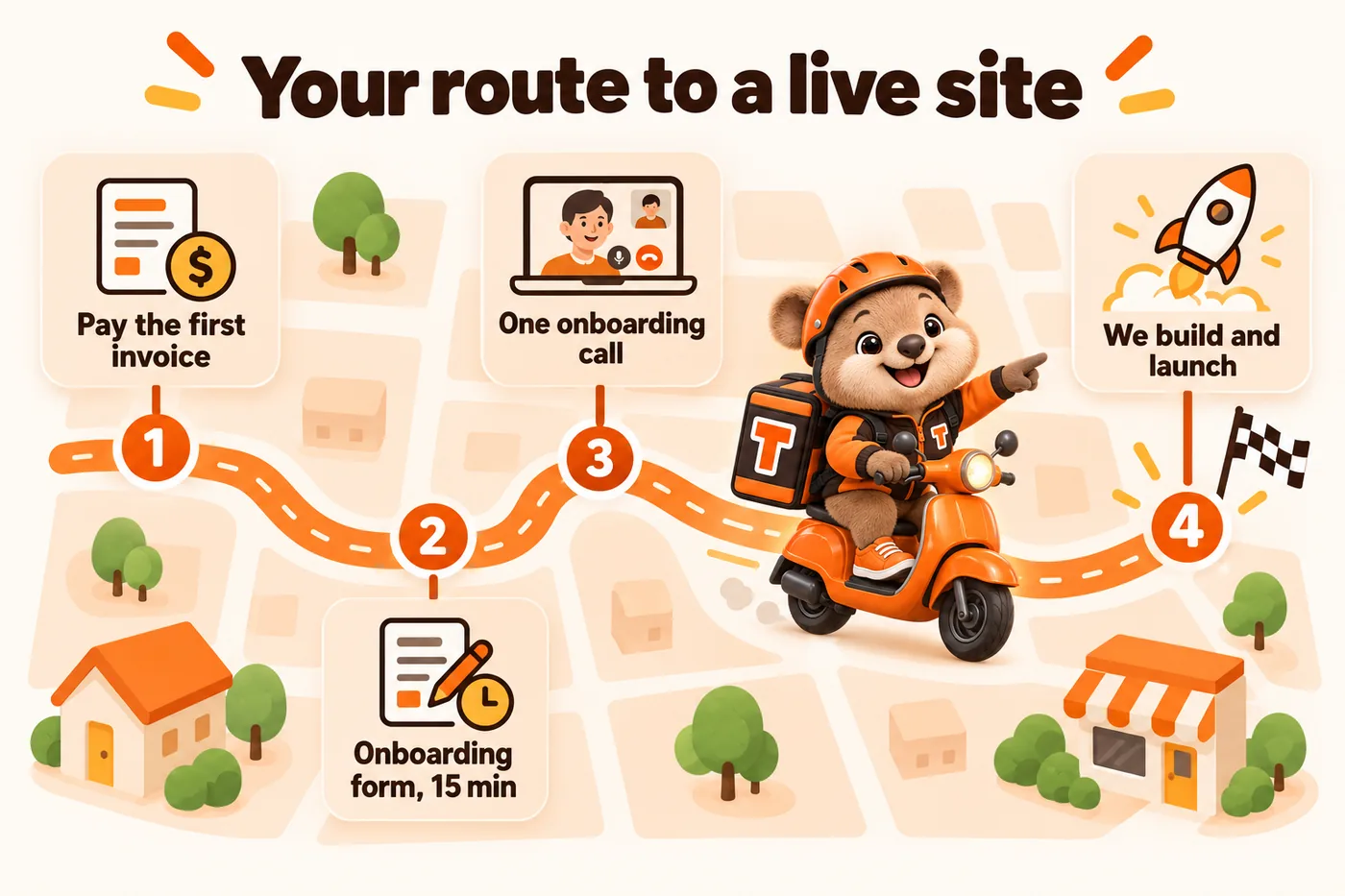
  1. 1

    You pay the first monthly invoice

    That starts the plan. The build fee is not charged yet.

  2. 2

    You fill in the onboarding form

    Menu, delivery zones, brand and where orders should land. About 15 minutes.

  3. 3

    One onboarding call

    We walk through your answers, fill the gaps and agree the launch date.

  4. 4

    We build and launch

    Live in 7 days on Order Starter. The build fee is invoiced only once you have approved the site.

Your route to a live site, drawn as Tito's delivery route: 1, pay the first invoice. 2, onboarding form, 15 min. 3, one onboarding call. 4, we build and launch

Pricing

Three plans, one build fee charged after launch

A $647 one-time build fee applies on every plan, invoiced only once the site is live and approved.

Order Starter

The website, fully managed

$117/ month

  • Live in 7 days
  • 2 articles a week
See what is included

Full Kitchen

Everything, plus the Content Engine

$597/ month

  • Live in 15 days
  • 3 articles a week
  • AI Engine included
  • Content Engine included
See what is included

All three plans include managed hosting, a free domain and owned online ordering. Full comparison.

Guarantees

The promises that are actually in the contract

Every line below is in the terms and conditions, not just on this page. If a claim only exists in marketing copy, it is not a guarantee.

  • 90+ PageSpeed, in writing

    We guarantee a Google PageSpeed score of 90+ on mobile and desktop for pages we build and host. If a page falls below it because of our work, we fix it at no charge.

  • Local rankings inside 3 to 5 months

    The terms commit to your site starting to rank for local searches in your area within 3 to 5 months of launch. If it has not, we continue the search work at no additional charge until it does.

  • The build fee is invoiced after you approve the site

    The $647 one-time build fee is not taken at signup. It is invoiced once your site is live and you have said you are happy with it, which is why it is not refundable afterwards.

  • No hourly billing, ever

    5 revisions a month are included and a revision has no size limit. After the fifth, each is a flat $20. Everything is completed within 2 to 5 working days.

  • The domain and your content stay yours

    Your domain is registered in your name, and if you leave you tell us where to send it and we transfer it at no charge. On cancellation we provide an export of your content and articles within 14 days.

  • Cancel with 2 business days notice

    By email, before your next invoice date. No lock-in period, no exit fee, no clause that keeps billing you for a site you asked us to stop.

The limits are stated too: neither guarantee covers changes you or a third party make, content published against our advice, or rankings for terms outside your area. Neither entitles you to a refund. The remedy is the corrective work, done at our cost.

Included, not an add-on

Your site ships with the pages a restaurant is expected to have

Written around what your site actually does: takes orders, quotes delivery zones, books catering, sends text messages. Not pasted out of a generator built for a software company.

  • Privacy policy

    A policy written around what your site actually collects: order details, contact forms, booking requests and analytics.

    Customers and payment providers expect one, and US state privacy laws such as the CCPA and CPRA set expectations about what you tell people.

  • Terms for online orders

    Order acceptance, delivery zones and minimums, pickup windows, substitutions, cancellations and refunds for orders placed on your site.

    When an order goes wrong, the terms decide the conversation. Vague terms turn a five dollar problem into a chargeback.

  • Cookie policy with consent that really gates scripts

    A cookie page plus a consent banner that actually holds non-essential scripts until someone agrees, rather than a banner that announces cookies it has already set.

    A banner that does nothing is worse than no banner: it states a promise the site is not keeping.

  • Accessibility statement

    A statement of how the site is built and how to report a barrier, backed by a build aimed at WCAG 2.2 AA and the ADA expectations that follow it: keyboard operable, real contrast, labelled form fields, alt text on menu photography.

    Accessibility complaints against restaurant websites are common, and an inaccessible menu quietly loses orders from people who would have bought.

  • Allergen and nutrition disclaimer

    A plain notice that menu descriptions come from your kitchen, that a shared kitchen cannot guarantee an allergen-free dish, and that customers should call with a serious allergy.

    You control the wording. We never write allergen, nutrition or food safety advice on your behalf, and the AI Engine routes those questions to a person.

  • Text message consent wording

    Consent language on any form that takes a mobile number, plus TCPA consent wording and A2P 10DLC registration handled as part of the build on the plans that include messaging.

    Carriers reject unregistered business texting, and consent wording is the part most small operators skip.

  • Review and testimonial handling

    Genuine reviews only, displayed as given, with no invented ratings or counts, in line with the Federal Trade Commission rule on consumer reviews and testimonials.

    We never write a review for you. Nothing on a site we build claims a rating that is not real.

  • Copyright, ownership and takedown

    Ownership of your content and photography stated plainly, with a contact route for anyone who believes an image is theirs.

    Menu photography is borrowed more often than anyone admits. Saying who owns what protects you.

These pages help you meet the expectations that apply to a restaurant website. They are not legal advice, and we are not your lawyer: if your state, county or franchise agreement adds a requirement, send it to us and we will build the page around it.

What clients say

Six kitchens, six specific changes

Each of these describes one thing that changed after launch, in the words of the person who runs that counter.

If you only look at the design you miss the best bit, which is the inquiry form. The form gathers delivery ZIP code, order time and menu category at the start, exactly the details our follow-up messages always requested. Most mornings I can prepare for the callback from the first message alone.

Ankita SethiAssistant manager, Thai takeaway kitchenSavannah, Georgia

Inquiry form and response workflow for takeaway ordering

Who we build for

Pick your kind of kitchen

Every sub-niche gets its own pains, pages and tool, not the same copy with the name swapped.

A website for a pizza shop that gets the order placed before the phone rings

A pizza takeaway website works when someone can build their order, from crust to toppings, without calling to ask what is available, and see a delivery time they can actually trust.

  • The current site links out to a delivery app for ordering, so the shop never sees the customer's details or a repeat order without the app taking its cut.
  • Toppings, sizes and combo deals live in a PDF that goes stale the moment a price changes.
See the full build for pizza

See every kitchen type we build for

The money argument

What moving orders to your own channel is worth

We are not going to tell you what a typical commission rate is, because your agreement is the only one that matters. Put your own three numbers in and the page does the arithmetic. Nothing is sent anywhere, and nothing is stored.

Enter your three numbers to see what a year on your own ordering channel is worth.

Your figures, your arithmetic. This is an illustration built from what you typed, not a quote, a forecast or a promise about your business. Plans start at $117 a month.

Six months from launch

What the kitchen looks like by then

  • Your menu has been right every week since launch, because changing it is a message rather than a job somebody has to find time for.
  • Between 52 and 78 researched articles have published, each one another way for somebody to find you before they open an app.
  • Every location, delivery area and catering path has a real page, so a search for your food near a neighborhood has something to land on.
  • The calls you used to lose after close were answered, and the details reached you, on the plans that include the AI Engine.
  • A share of your regulars order on your own domain now, so those tickets carry no third-party commission at all.

None of that is automatic and none of it is a promise about revenue. It is what the plan actually does every week: launch in 7 days, then publish, maintain and fix, with 5 changes a month of any size included.

See the three plans

See your menu built into a site like this, on a real call

Thirty minutes, on your screen, with a build for your kind of kitchen. No slides, no pressure, plans from $117 a month.

Book a demo

Questions

Straight answers on the offer

What do I actually get for the monthly fee?

A full website built for a takeaway, delivery or fast casual kitchen: a menu that reads clearly, ordering that stays on your own site, delivery zone and pickup time pages, managed hosting, and weekly researched articles. Plans start at $117 a month, with a $647 one-time build fee invoiced only after your site is live and you have approved it.

How long until my site is live?

7 days on Order Starter, 10 on Order Engine while the AI Engine is trained on your menu and policies, and 15 on Full Kitchen with the Content Engine running. The clock starts at the onboarding call, not at purchase, so the sooner the form is in, the sooner you are live.

Can the site handle both delivery and pickup, or just one?

Both. The ordering flow asks the customer to choose delivery or pickup upfront and shows the correct time estimate, minimum order and any delivery zone restriction for whichever they pick, rather than treating every order the same way.

What happens straight after I buy?

You fill in the onboarding form and submit it. It asks for your menu, delivery zones or coverage area, brand, domain and where orders should land, and it takes about 15 minutes. If something is missing, submit anyway: you can send the rest by email or raise it as a ticket in your client portal, and it will not hold up the build. We then run one onboarding call to fill any gaps and agree the launch date.

What is the client portal?

It is your account with us, and you get it the day your site goes live. From the portal you request revisions, raise a support ticket for anything that needs attention, send us files you still owe us, and message our team directly. Everything to do with your site runs through it, so nothing gets lost in an inbox. You never log in to the website itself; we handle that side.

How fast will my menu page actually be?

Every page is built to a 90+ Google PageSpeed score on mobile and desktop, and that target is in the terms rather than in a sales line. Pages are custom coded, ship almost no JavaScript and are served from a global edge network. If a page ever falls below the target because of our work, fixing it is on us.

Does a faster site make my ads cheaper?

It can help, and we will not promise a number. Two things are true. You pay for a click before anyone sees the page, so every visitor who gives up during a slow load is money already spent. And the landing page is part of how an ad platform rates your ad: Google Ads Help describes ad quality as an estimate of the experience people have when they see your ad and once they reach your landing page, and says higher ad quality generally leads to better performance, including better ad positions and lower cost. Anyone quoting you a specific cost-per-click drop is guessing.

Who checks the speed after launch?

We do, every week, as part of the plan. A new photograph, a new page or an added embed can all drag a score down, which is why the check is scheduled rather than left until someone complains.

What do you actually do for SEO?

The technical work and the pages that carry it: titles, descriptions, headings, canonical addresses, sitemaps, internal links and image alt text, on a fast site, plus a page for each location and each delivery area you really serve. We do not build empty pages for towns you do not deliver to, because search engines filter that and it drags down the honest pages.

What is AEO, and why does it matter for a takeaway?

Answer engine optimization is writing so the answer can be lifted out: the first sentence under a heading answers the heading, and facts like delivery radius, pickup window and catering lead time are stated plainly. That is the structure that gets pulled into a featured snippet or a voice answer, which for a hungry customer is often the only result they see.

See every question, grouped

Tito, the GetRestaurantSite mascot, riding out of a takeaway shop on his scooter with an order

Ready to stop losing orders to a slow menu page?

Plans from $117 a month, a $647 build fee invoiced only after launch, domain and hosting included.