Book a demo

A website for a Chinese or Asian takeaway built around combo boxes and phone-in regulars

An Asian takeaway website earns repeat business when regulars can reorder their usual combo in a few taps instead of reciting it over the phone every time.

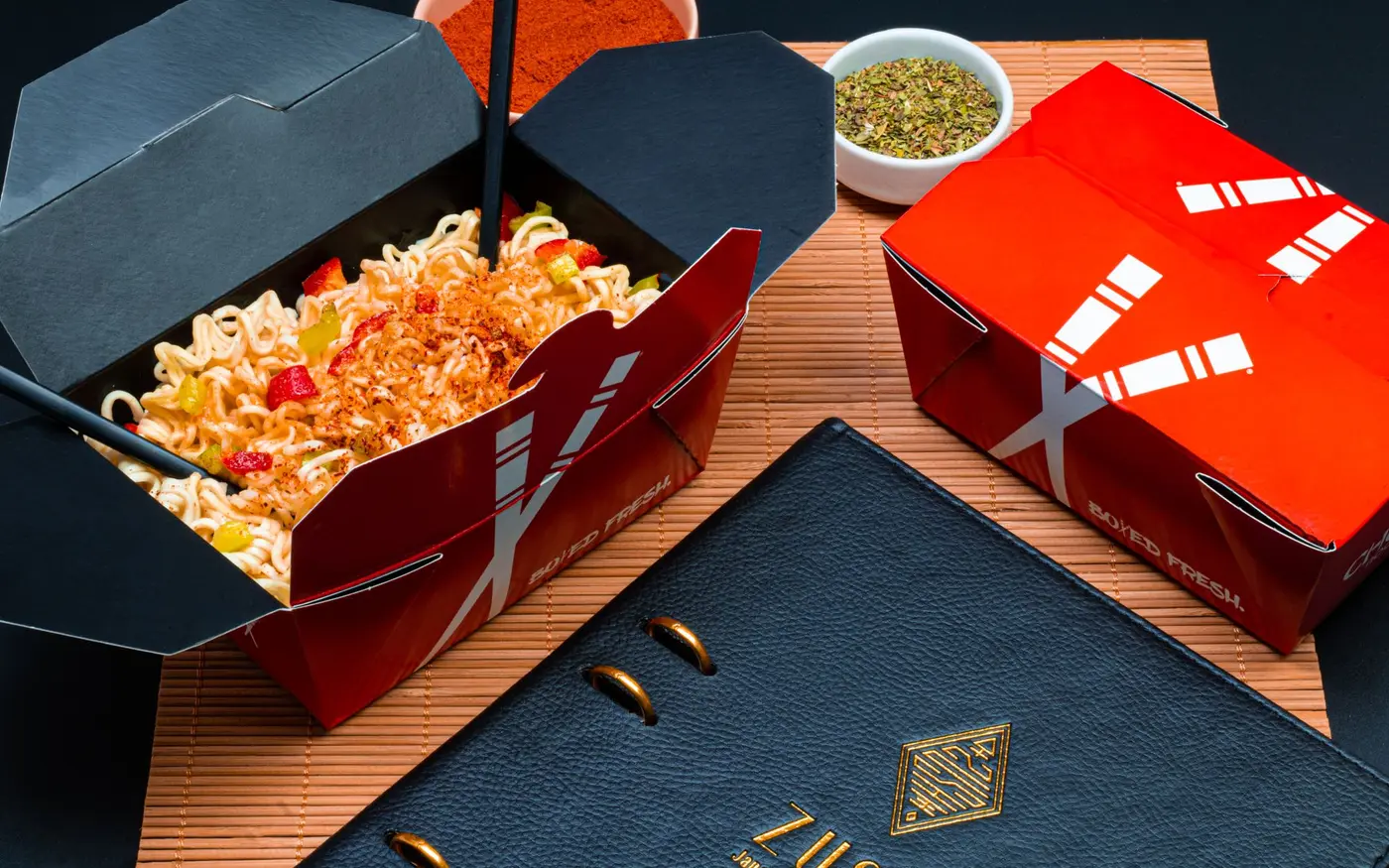
Asian noodles packed into takeout boxes with chopsticks and spices beside a menu
Photo by Yusuf Celik on Pexels

Common problems

What usually goes wrong for asian and chinese takeaway

  • Long menus with dozens of combination plates are crammed into a single unreadable page.
  • Regulars still call in because the site has no real way to reorder a saved combination.
  • Spice levels, protein swaps and side substitutions are not represented anywhere online.
  • The site reads the same in every town the brand operates in, so none of the location pages actually rank.

Page architecture

The pages your site will carry

  1. Home
  2. Full menu by section
  3. Combination plates and specials
  4. Build-your-own order flow
  5. One page per location
  6. Delivery zone and pickup times
  7. Reviews
  8. Contact

Combo builder

A structured way to present combination plates with protein, side and spice-level choices, so a long menu stays scannable instead of becoming a wall of text.

From this kind of kitchen

What owners running asian takeaway say changed

  • If you only look at the design you miss the best bit, which is the inquiry form. The form gathers delivery ZIP code, order time and menu category at the start, exactly the details our follow-up messages always requested. Most mornings I can prepare for the callback from the first message alone.

    Ankita SethiAssistant manager, Thai takeaway kitchenSavannah, Georgia

    Inquiry form and response workflow for takeaway ordering
  • The guided contact options looked like a small feature; they changed the inbox. The sender picks the route, which means the best-informed person does the sorting. Visitors get a simpler page and we get a clearer inbox.

    Mark EllsworthShift coordinator, Chinese takeaway with collection counterTacoma, Washington

    Inquiry categories and guided navigation for takeaway ordering

What you send us

  • Your menu, in whatever form it exists today
  • Delivery zones or the area you cover, and your pickup windows
  • Opening hours, including the ones that change at the weekend
  • Logo and photographs if you have them
  • Where an order should end up: an email, a printer, a point-of-sale system

About fifteen minutes of onboarding form, then one call. Send it incomplete if that is faster; missing pieces do not hold up the build.

What we handle

  • Design, build, copy and every page on the site
  • The ordering flow on your own domain, connected to your kitchen
  • Domain, hosting, SSL, backups and the weekly speed check
  • 5 revisions a month, each completed within 2 to 5 working days
  • Researched articles, structured data and the policy pages

You never log in to the website. Changes go through the client portal and come back within 2 to 5 working days.

Plan by plan

What each plan adds for asian takeaway

Every plan carries the website, the ordering flow, hosting, revisions and articles. These are the differences.

  • Order Starter

    Live in 7 days · 2 articles a week

    • Pages that open instantly
    • Menu pages built to be craved
    • Ordering that stays on your site
    • Delivery zones and pickup times, set once
    • A real page for every location
    • Reviews shown where they influence the order
    • Found in search, in maps and in AI answers
    • Researched articles, published on a schedule
    • Hosting, security and backups, handled
    • Moving off your current site, without losing what you built
    • The policy pages your site ships with
    • One place for revisions, tickets and files
  • Order Engine

    Live in 10 days · 2 articles a week

    • The AI Engine
    • The AI receptionist for calls you cannot take
    • A chat widget that answers instead of collecting emails
    • Text messaging that replies while you are plating
  • Full Kitchen

    Live in 15 days · 3 articles a week

    • The Content Engine
    • Social posts and reels, drafted from the same research

Every feature, with the plan that carries it

Search, answers and AI

How asian takeaway get found, in search and in AI answers

Four different jobs, all included on every plan. People still search, but they also ask an assistant, and a kitchen that is invisible to one is usually invisible to both.

SEO

The technical work, plus pages that deserve to rank

Titles, descriptions, headings, canonical addresses, sitemaps, internal links and image alt text handled properly, on a site fast enough to be crawled and enjoyed. Then the pages themselves: one per location, one per area you really deliver to, one per menu section worth its own page.

Location pages are built for your cities and neighborhoods, which is where a search near a place turns into an order.

AEO

Written so the answer can be lifted out

Answer engine optimization means the first sentence under a heading answers the heading, and the facts a customer asks for, delivery radius, pickup window, catering lead time, allergen policy, are stated plainly instead of buried.

FAQ blocks are visible on the page and marked up, never markup alone. Hidden answers break the rules and help nobody.

GEO

Citable by ChatGPT, Claude, Perplexity and AI Overviews

Assistants summarise sites they can parse and trust. Your site publishes a plain-text llms.txt describing the kitchen and its key pages, keeps your name, address, hours and service area identical everywhere, and states facts in a quotable form.

Nobody can guarantee an appearance in an AI answer, and we do not. We control whether you are readable, consistent and worth quoting.

Schema

Structured data generated from the visible page

JSON-LD for the business itself with hours, address and service area, for each service or menu page, for your FAQ blocks and for breadcrumbs, all generated from the same content a visitor reads so the two never drift apart.

Review markup is added only where you have genuine reviews. We never generate a rating that does not exist.

We build location and service-area pages for the places you actually trade in, and never for towns you do not deliver to. Empty doorway pages get filtered and drag down the pages that were honest.

The terms commit to your site starting to rank for local searches in your area within 3 to 5 months of launch, and to continuing the search work at no extra charge if it has not.

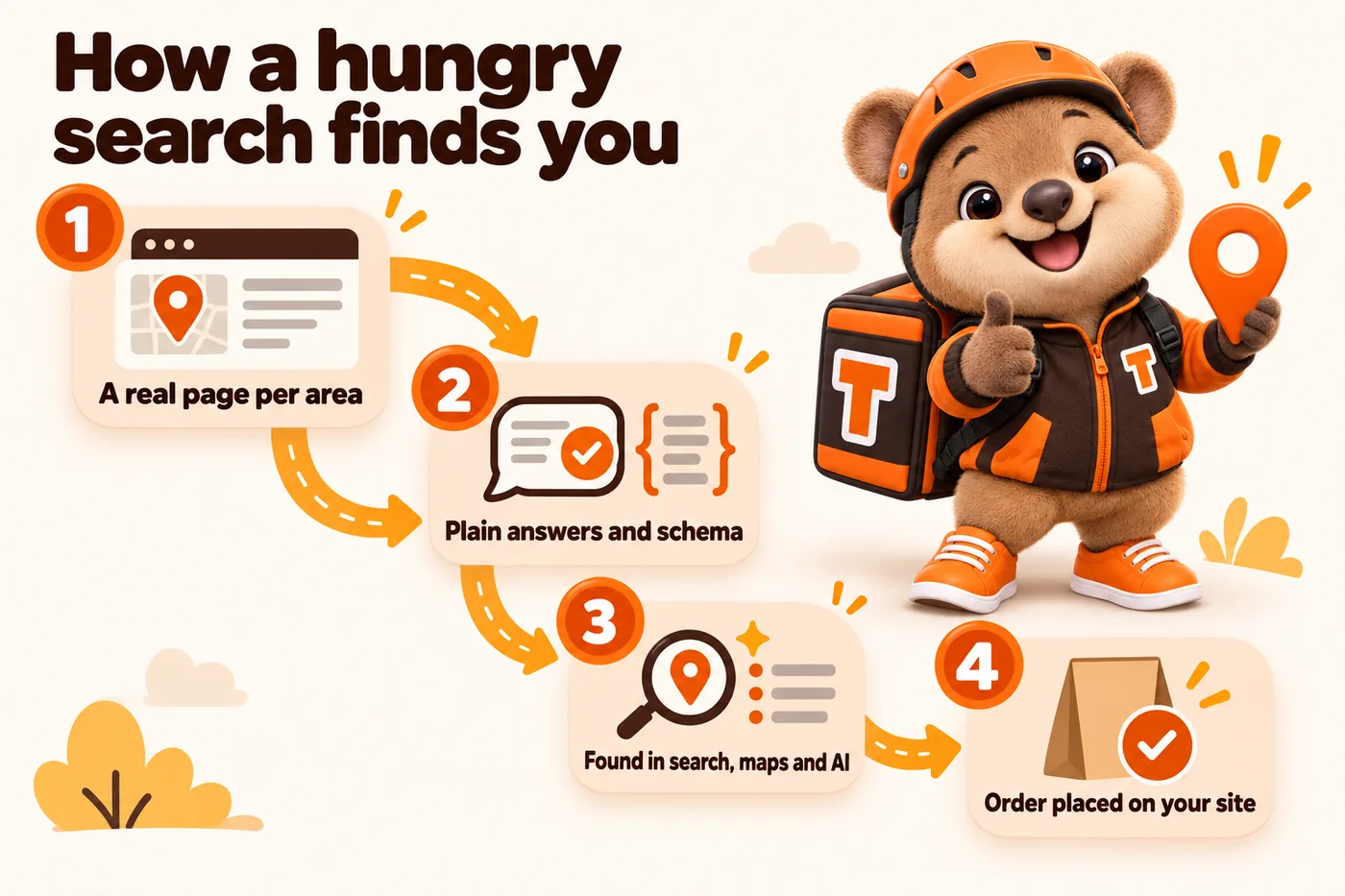
How the local search work runs
How a hungry search finds you: 1, a real page per area. 2, plain answers and schema. 3, found in search, maps and AI. 4, order placed on your site. Tito gives a thumbs-up at the last stop

Included, not an add-on

The policy pages your site ships with

Written around what your site actually does: takes orders, quotes delivery zones, books catering, sends text messages. Not pasted out of a generator built for a software company.

  • Privacy policy

    A policy written around what your site actually collects: order details, contact forms, booking requests and analytics.

    Customers and payment providers expect one, and US state privacy laws such as the CCPA and CPRA set expectations about what you tell people.

  • Terms for online orders

    Order acceptance, delivery zones and minimums, pickup windows, substitutions, cancellations and refunds for orders placed on your site.

    When an order goes wrong, the terms decide the conversation. Vague terms turn a five dollar problem into a chargeback.

  • Cookie policy with consent that really gates scripts

    A cookie page plus a consent banner that actually holds non-essential scripts until someone agrees, rather than a banner that announces cookies it has already set.

    A banner that does nothing is worse than no banner: it states a promise the site is not keeping.

  • Accessibility statement

    A statement of how the site is built and how to report a barrier, backed by a build aimed at WCAG 2.2 AA and the ADA expectations that follow it: keyboard operable, real contrast, labelled form fields, alt text on menu photography.

    Accessibility complaints against restaurant websites are common, and an inaccessible menu quietly loses orders from people who would have bought.

These pages help you meet the expectations that apply to a restaurant website. They are not legal advice, and we are not your lawyer: if your state, county or franchise agreement adds a requirement, send it to us and we will build the page around it.

Pricing

Three ways to run it

Order StarterThe website, fully managedLive in 7 days
Order EngineEverything, plus the AI EngineLive in 10 days
Full KitchenEverything, plus the Content EngineLive in 15 days

Compare the plans in full, including the $647 build fee

Be fair about it

Weighing us against a builder, an app or an agency

There are cheaper ways to have a website and better ways to spend money than on us, depending on your kitchen. We wrote ten comparisons that say so out loud, including the cases where you should stay exactly where you are.

Read all ten comparisons

Every page names what the other option is genuinely better at, and how the two can work together.

Questions from asian and chinese takeaway

Our menu has over a hundred items. Can the site handle that?

Yes. We structure a large menu into clear sections and combination groups rather than one long list, so both search engines and hungry visitors can actually navigate it.

Can customers save a favorite order to reorder later?

A saved or recent order shortcut can be built into the ordering flow as part of the site. The specifics are scoped during onboarding based on how you take repeat orders today.

Do you support multiple spice levels and substitutions?

Yes. Modifiers like spice level, protein swaps and side substitutions are built into the ordering flow so a customer configures the dish correctly the first time.

We have locations in three different towns. Does each get its own page?

Yes. Each location gets its own real page with its own hours, delivery zone and any menu differences, rather than one shared page listing every address.

Can the menu show dishes in more than one language?

Dish names can be shown alongside a second script or a transliteration where your customers expect it. The site itself ships in US English today, and the structure is built so another language is a content job rather than a rebuild.

How do you handle a menu with numbered dishes?

Numbers stay, because your regulars order by them and your kitchen works by them. We keep the numbering visible and searchable so somebody can find number 47 without scrolling a hundred rows.

Can we show which dishes are spicy or contain nuts?

Yes, using labels you control and wording you give us. We never write allergen or nutrition advice for you, and the site carries a plain disclaimer telling customers with a serious allergy to call the kitchen.

Do the location pages read differently for each town?

They have to, or none of them rank. Each one carries its own hours, delivery area, landmarks, parking notes and anything the kitchen does differently there. We ask you for those details rather than inventing local colour.

See it built for asian takeaway

A live walk-through, on your screen, of the site you would get.

Book a demo